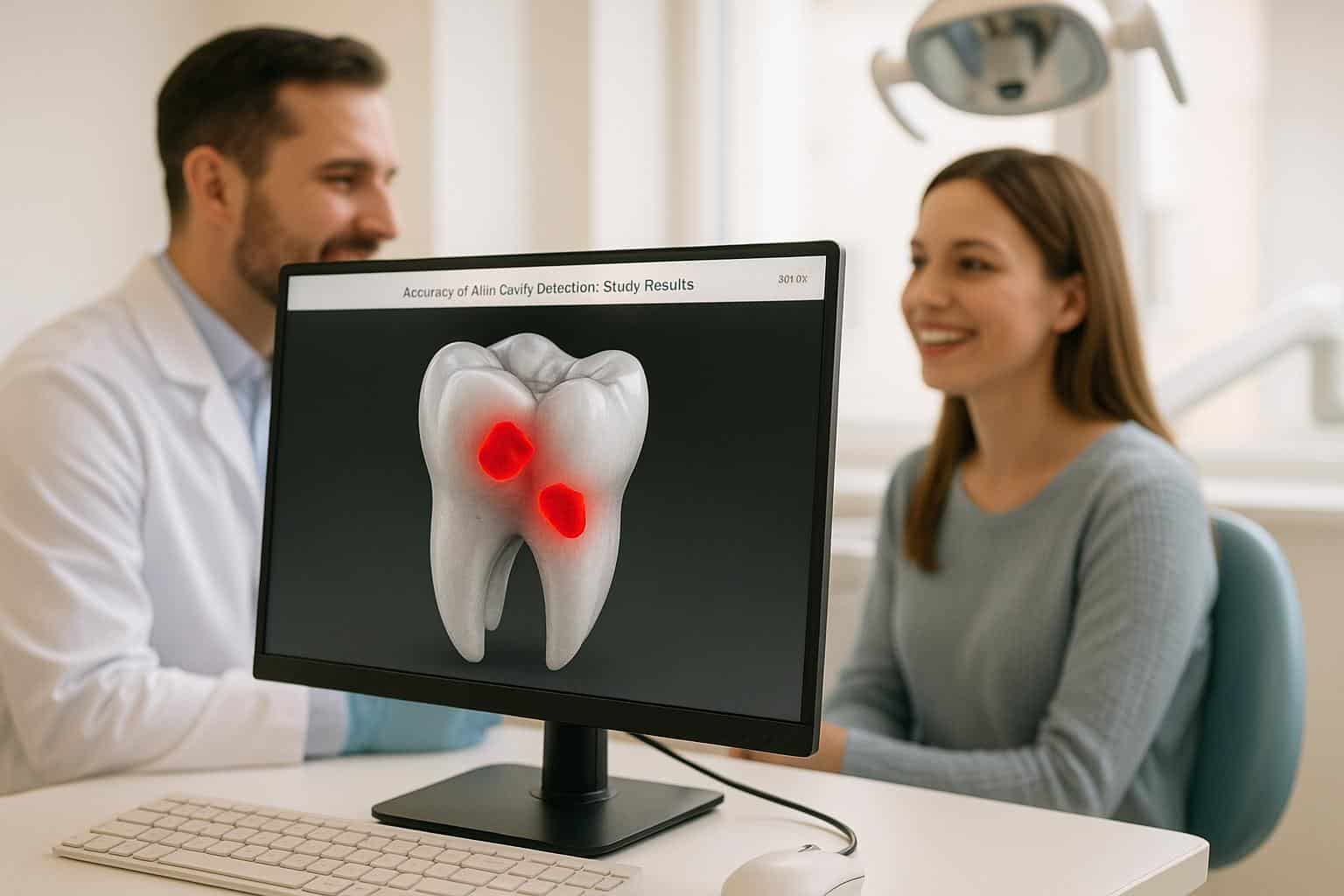
AI can detect cavities with over 90% accuracy, outperforming traditional methods. It identifies early signs of decay that are often missed by dentists, providing faster, more consistent diagnoses. AI tools like CNNs analyze dental X-rays in seconds, improving sensitivity (up to 94%) and specificity (up to 91%) compared to human experts.
Key Highlights:
- AI Accuracy: Ranges from 86% to 99%, with some models achieving 93.40% overall accuracy.
- Human Dentists: Sensitivity averages 24%-36%, often missing early decay.
- Benefits:
- Early detection enables less invasive treatments.
- Reduces diagnostic errors by 37%.
- Improves patient understanding with visual overlays.
- Challenges:
- High costs, integration issues, and potential algorithm bias.
AI is transforming dental care, helping dentists deliver faster, more accurate diagnoses while enhancing patient outcomes.
How AI Detects Cavities
AI Technology and Algorithms
AI-powered cavity detection uses advanced algorithms to analyze dental images with incredible precision. At the forefront are Convolutional Neural Networks (CNNs), known for their strength in processing image data and identifying intricate patterns that signal tooth decay. These networks segment X-ray images, diving into pixel-level details to spot subtle changes in density that often mark early stages of decay. CNNs are trained on thousands of images, ensuring they can recognize even the smallest signs of trouble.
Beyond CNNs, other models like Artificial Neural Networks (ANNs), Deep Neural Networks (DNNs), Support Vector Machines (SVMs), and Random Forests add to the toolkit, enhancing detection capabilities. Deep learning methods, in particular, shine by automating feature extraction, enabling the system to pinpoint diagnostic markers without needing manual input. When working with smaller datasets, techniques like transfer learning allow these models to adapt quickly and efficiently, improving their performance without requiring massive amounts of data.
Comparative studies highlight the strengths of various architectures. For example, ResNet-50 and DenseNet are highly accurate but demand significant computational resources. On the other hand, EfficientNet strikes a balance, making it ideal for environments with limited resources. For speed and accuracy, Faster-RCNN offers top-notch precision, while YOLOv5 delivers faster processing times, making it suitable for real-time applications. Together, these algorithms integrate seamlessly into dental workflows, revolutionizing how cavities are detected and diagnosed.
Workflow in Dental Practices
Incorporating AI into dental practices has transformed the diagnostic process, making it faster and more accurate. When a patient undergoes a dental X-ray, the image is instantly processed by AI algorithms. These systems analyze the radiograph in real time, identifying critical features like roots, bone density, and any signs of potential issues.
AI doesn’t stop at the obvious. It detects early signs of demineralization, incipient lesions, bone loss patterns, and even tiny fracture lines – details that are often missed during visual examinations. This analysis happens within seconds, giving dentists a comprehensive overview that supports quicker and more precise diagnoses, ultimately streamlining treatment planning.
According to research by Pearl AI, human dental examinations miss 43% of cavities visible in X-rays, and dentists often misjudge the depth of lesions 40% of the time. AI addresses these gaps by improving disease detection rates by 37%. This leap in diagnostic accuracy translates into better, faster decisions for patient care, leading to improved treatment outcomes and a more efficient workflow for dental professionals.
06 How Accurate is Artificial Intelligence in Detecting Dental Caries?
AI vs. Standard Diagnostic Methods
When comparing AI to traditional methods for detecting cavities, the differences in performance and reliability are striking. Studies suggest that AI systems often deliver more consistent results than human examinations. Meanwhile, older methods like visual inspections and radiography face inherent limitations. These distinctions become even clearer when examining diagnostic metrics.
Key Metrics: Sensitivity and Specificity
The accuracy of diagnostic tools is typically measured by sensitivity and specificity. A meta-analysis of seven studies revealed that AI systems achieved a mean sensitivity of 76% (95% CI: 65%–85%) and a specificity of 91% (95% CI: 86%–95%). Their overall accuracy ranged from 78.2% to 81.5%, with an AUC (area under the curve) of 92% (95% CI: 89%–94%).
| Diagnostic Method | Sensitivity | Specificity | Overall Accuracy | AUC |
|---|---|---|---|---|
| AI Systems | 76% (65%–85%) | 91% (86%–95%) | 78.2%–81.5% | 92% (89%–94%) |
| Traditional Methods | 71% average | 83% average | Variable | Not specified |
| Human Dentists | 75% average | 36%–83% range | 71% average | Variable |
In some cases, AI systems outperformed human dentists in sensitivity. One study reported an 80% overall accuracy for AI, with a sensitivity of 75%, compared to just 36% for human dentists. Another study using intraoral images found AI systems achieving 81.31% sensitivity, 95.65% specificity, and an impressive overall accuracy of 93.40%.
Advanced AI models have pushed these numbers even further. For instance, ResNet-50 models reached 92% accuracy with 87.33% sensitivity and 96.67% specificity. DenseNet-12 models performed similarly, reporting 91.83% accuracy. Some specialized neural networks have even achieved accuracy rates as high as 99.13%.
These statistics highlight AI’s ability to deliver consistent and reliable results, often surpassing traditional diagnostic methods.
Study Insights and Trends
Recent studies shed light on AI’s strengths and limitations. While AI is particularly effective at identifying occlusal and proximal caries, its performance in detecting cervical caries remains less impressive. AI systems process radiographs quickly, offering standardized diagnoses and speeding up treatment. However, variability across different platforms and potential testing biases are areas of concern.
AI has shown remarkable potential in identifying early-stage caries. For example, ResNet-152 CNN models have demonstrated the ability to distinguish pathological tooth structures more accurately than even experienced clinicians.
Randomized controlled trials, such as those evaluating dentalXrai Pro 1.0.4 and AssistDent AI, further emphasize AI’s role in improving diagnostic accuracy. These tools provide reliable second opinions, proving invaluable in cases where diagnoses are particularly challenging.
sbb-itb-fb98d5c
Benefits and Challenges of AI in Cavity Detection
AI has proven to be a valuable tool in cavity detection, delivering impressive diagnostic accuracy. However, its implementation comes with its own set of hurdles. By understanding both the advantages and challenges, dental professionals can make smarter decisions about adopting these advanced systems.
Advantages of AI-Powered Diagnostics
AI-powered diagnostic tools bring consistency to the table, ensuring uniform analysis of radiographs. This is especially beneficial for dental practices operating across multiple locations, where maintaining consistent care standards can be tricky.
Another major perk is real-time processing of radiographs, which saves time and lightens the workload for clinicians. AI also excels at spotting early-stage cavities, achieving over 90% accuracy – often surpassing human performance.
Beyond accuracy, AI visual overlays make it easier for patients to grasp their diagnosis, which can lead to a 10–20% increase in treatment acceptance rates.
Human error in diagnostics is another area where AI shines. Studies reveal that up to 4% of diagnostic interpretations may include significant mistakes, which AI can help minimize. Systems like Overjet have shown to enhance diagnostic consistency, enabling earlier and more confident detection of cavities.
Lastly, AI’s ability to analyze large datasets helps identify patterns across diverse populations. This makes it particularly useful for spotting rare conditions and tracking disease progression over time.
Limitations and Areas for Improvement
Despite its benefits, incorporating AI into dental practices isn’t without challenges. One of the biggest hurdles is the high upfront and maintenance costs, which can deter adoption – even as the market for AI tools continues to grow.
Integrating AI with existing systems can be complex, often requiring technical expertise and additional staff training. On top of that, the increasing volume of data raises concerns about security and privacy, a worry shared by 37% of Americans.
Another issue is algorithm bias, which can arise from limited or non-representative datasets. This highlights the importance of diverse training data. Additionally, there’s ongoing debate about whether AI could undermine human expertise. Experts emphasize that AI should complement, not replace, clinicians.
Resistance to adopting new technologies and gaps in technical skills within practices further complicate the integration process.
Here’s a quick comparison of AI’s strengths and challenges:
| AI Benefits | AI Challenges |
|---|---|
| 90%+ accuracy in detecting cavities | High implementation and maintenance costs |
| 10–20% boost in treatment acceptance | Integration difficulties with current systems |
| Real-time radiograph analysis | Data security and privacy risks |
| Standardized diagnostics | Potential algorithm bias |
| Early detection of cavities | Resistance from clinicians |
| Fewer diagnostic errors | Lack of technical expertise in teams |
To make the most of AI, dental practices need to tackle these challenges head-on. This means investing in proper training, strengthening data security measures, and fostering collaboration between clinical and technical teams. Practices that approach AI thoughtfully are well-positioned to improve both patient care and operational efficiency.
Impact on Dental Practices and Patient Care
The integration of AI into dental practices is reshaping how care is delivered and managed. With 35% of dentists worldwide now incorporating AI into their workflows and 77% reporting positive results, the technology is proving to be a game-changer across various clinical settings. It’s paving the way for better clinical outcomes and smoother practice operations.
Improving Patient Care with AI
AI is revolutionizing patient care, particularly in cavity detection. By reducing diagnostic times by 50%, AI-powered tools allow dentists to spend more time engaging with patients and providing thorough consultations. This shift not only improves efficiency but also enhances the overall patient experience.
When it comes to accuracy, AI-powered imaging tools are setting a new standard. While traditional X-rays achieve about 40% accuracy, AI tools can detect caries with up to 90% accuracy. This high level of precision empowers dentists to make immediate and confident treatment decisions.
Patient satisfaction has also seen a notable boost – up by over 35% – thanks to AI-driven tools. Features like visual overlays help patients better understand their oral health, enabling more informed decisions about their treatment plans.
AI’s ability to consistently identify subtle conditions ensures a level of diagnostic consistency comparable to that of specialists. This reduces variability in diagnoses and ensures that all patients receive the same high-quality care.
AI isn’t just improving clinical care – it’s also enhancing administrative efficiency. Practices that use AI-powered chatbots for administrative tasks report up to 25% savings in operational costs. Similarly, clinics employing AI billing systems experience 40% faster processing times and a 15% drop in billing errors. These benefits extend beyond diagnostics, streamlining the overall management of dental practices.
Here’s a snapshot of how AI performs across various dental conditions:
| Conditions | Sensitivity | Specificity |
|---|---|---|
| Caries | 91.0% | 87.0% |
| PA lesions | 86.6% | 98.3% |
| Crowns | 97.1% | 99.6% |
| Open crown margins | 82.6% | 91.9% |
| Restoration | 89.3% | 96.4% |
| Endodontic treatment | 93.4% | 99.3% |
| Calculus | 80.2% | 97.8% |
| Marginal bone loss | 91.1% | 93.1% |
Shoal Creek Smile Studio‘s Approach
Some dental practices are setting new standards by seamlessly integrating AI into their daily operations. Shoal Creek Smile Studio is a prime example of how modern technology can elevate patient care. This practice uses advanced tools like digital X-rays and intraoral cameras to ensure precise diagnoses and effective treatments.
Shoal Creek Smile Studio reflects a growing trend among small to mid-sized practices, which are increasingly adopting AI due to the affordability and scalability of cloud-based tools. Their approach includes the use of digital scanning and comprehensive diagnostic tools to provide detailed oral health assessments, such as full-mouth X-rays, oral cancer screenings, and gum health evaluations.
Notably, their $150 New Patient Special offers a combination of advanced diagnostics, patient education, and personalized care, ensuring a thorough and informed experience for every patient.
Conclusion: The Future of AI in Dentistry
AI is proving to be a game-changer in dentistry, especially in detecting cavities. Studies show its accuracy ranges from 86% to 95%, with some models even hitting 99% – a marked improvement over traditional methods. A 2023 study in Nature Digital Medicine revealed that AI-assisted imaging boosted cavity detection accuracy by 30% compared to standard practices.
These advancements are making a real difference in clinics. For example, Denti.AI can analyze X-rays in seconds and identify early decay with 92% accuracy. Meanwhile, VideaHealth‘s AI predicts cavity risks six to twelve months ahead with an 89% success rate. AI-guided prevention plans have also reduced cavity rates by 35% among high-risk patients.
One of AI’s standout capabilities is detecting subtle decay that often goes unnoticed. A 2024 Journal of Clinical Dentistry study found that AI-assisted smartphone scans identified 85% of early cavities missed by standard visual exams. This addresses a significant limitation in traditional diagnostics.
It’s important to note that AI doesn’t replace dentists – it complements them. Research shows that combining AI’s precision with clinical expertise improves disease detection rates by 37% and boosts patient trust by 71%.
AI’s role is expanding from detection to prevention. Predictive modeling is enabling more personalized care, with AI now forecasting caries risk and tailoring prevention strategies. As of 2024, around 30–35% of U.S. dental practices have already adopted AI, signaling a transformative shift in the field.
The key to success lies in thoughtful integration. Dentists who merge AI’s capabilities with their clinical skills are not just improving detection – they’re setting the stage for better preventive care. Practices like Shoal Creek Smile Studio are already showcasing how these advancements can elevate patient outcomes.
FAQs
How does AI enhance cavity detection compared to traditional methods?
AI is transforming cavity detection by employing advanced machine learning models, such as neural networks, to examine dental X-rays and images with impressive precision. These tools can spot early-stage cavities and subtle issues that might escape notice during traditional manual or visual inspections.
Recent research reveals that AI systems boast accuracy rates above 93%, paired with strong sensitivity and specificity. This significantly lowers the risk of false positives or missed cavities, allowing dentists to deliver earlier and more dependable diagnoses. By integrating AI into dental care, providers can take a more proactive approach, leading to better treatment results and healthier patients overall.
What challenges come with using AI in dental practices, and how can they be overcome?
Integrating AI technology into dental practices comes with its own set of challenges, such as concerns over data privacy, ethical dilemmas, potential workflow disruptions, and the need for specialized training for staff. If not handled properly, these obstacles could slow down the adoption process.
To tackle these issues, dental practices can take several proactive steps. Establishing clear ethical guidelines ensures that the use of AI aligns with professional standards and patient trust. Investing in thorough staff training helps team members feel confident and capable when working with new systems. Strong data security protocols are crucial for safeguarding sensitive patient information. Taking a phased approach to integration, along with careful strategic planning, can also reduce disruptions and make the transition to AI-powered tools smoother and more manageable.
Can AI technology in dentistry replace dentists, or does it work alongside them?
AI in dentistry is here to work with human dentists, not take their place. Research highlights how AI boosts diagnostic precision and simplifies workflows, allowing dentists to dedicate more time to personalized care and tackling complex cases.
While AI tools are excellent at spotting cavities and other dental problems quickly, they can’t match the expertise, critical thinking, or empathetic care that only a dentist can provide. Instead, these technologies act as helpful partners, enhancing patient outcomes and making treatments more accurate and efficient.